
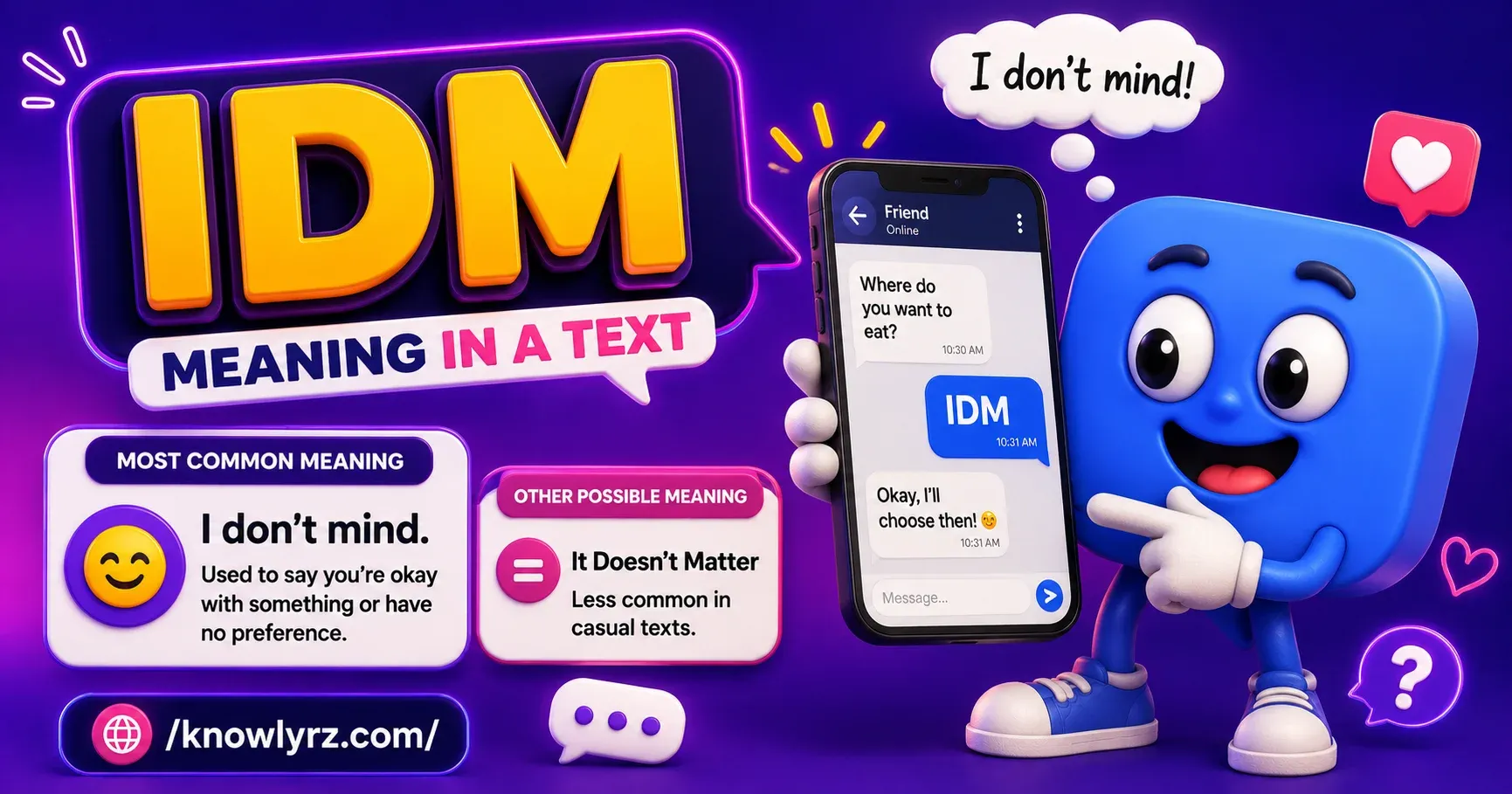
If you have received a message containing IDM, you may be wondering what it means. Internet slang can be confusing because the same abbreviation may have different meanings depending on the conversation, platform, and relationship between the people talking.
The most common meaning of IDM in text is I Don’t Mind.
People use IDM when they want to show that they have no strong preference about something. It can mean that they are okay with either option, willing to agree with someone else’s choice, or simply not bothered by the situation.
For example, if someone asks, Do you want pizza or burgers?, you might reply, IDM, you choose.
In that situation, IDM means I Don’t Mind.
However, context is important. IDM can occasionally have other meanings in technology, music, business, and online communities. This complete guide explains the meaning of IDM in texting, how to use it correctly, examples, alternative meanings, common mistakes, and the difference between IDM and similar expressions.
What Does IDM Mean in Text?
In texting and casual online conversations, IDM usually stands for I Don’t Mind.
It is commonly used when someone does not have a particular preference.
For example:
Person 1: Do you want to watch a movie or a series?
Person 2: IDM, either is fine.
The second person is saying that they are happy with either choice.
IDM is a convenient abbreviation because it allows people to give a quick and relaxed response without writing a longer sentence.
The phrase I Don’t Mind can communicate several slightly different ideas depending on the situation.
It may mean:
- I am okay with that
- Either option is fine
- You can choose
- I have no preference
- That does not bother me
- I am happy with whatever happens
- I do not object
- It makes no difference to me
Because of this flexibility, IDM is useful in everyday conversations.
The Simple Definition of IDM
The easiest way to understand IDM is:
IDM = I Don’t Mind
When someone says IDM, they usually mean that they are comfortable with the suggested option.
For example:
Can we meet at 6 PM?
IDM.
This means:
I don’t mind meeting at 6 PM.
The person is agreeing and showing that the proposed time is acceptable.
IDM Meaning in Texting and Chat
IDM is most commonly seen in informal digital communication.
People may use it in:
- Text messages
- WhatsApp conversations
- Instagram messages
- Snapchat chats
- TikTok comments
- Discord conversations
- Gaming chats
- Facebook Messenger
- Online group chats
The abbreviation is particularly useful when people are discussing choices.
Imagine that your friend asks:
Should we go out today or tomorrow?
You could say:
IDM, whatever works for you.
This means you do not have a strong preference between today and tomorrow.
IDM often makes a response sound relaxed and easygoing.
Instead of arguing about a small decision, the person is allowing someone else to choose.
IDM Can Show Flexibility
One of the biggest reasons people use IDM is to show flexibility.
For example:
Do you want the blue one or the black one?
IDM, both look good.
The response communicates that the person does not strongly prefer one option.
This can make conversations easier because the other person knows they are free to decide.
IDM Can Also Mean Something Does Not Bother You
Sometimes IDM is not about choosing between two options.
It can also mean that something does not cause a problem for you.
For example:
Is it okay if I bring my friend with me?
IDM.
This means:
I don’t mind if you bring your friend.
The person is giving permission or showing that the situation is acceptable.
How Is IDM Used in Conversations?
IDM is easy to use, but understanding the context helps you use it naturally.
Usually, someone asks a question, suggests an idea, or gives two options. The other person responds with IDM to show they are okay with the situation.
Here are some common situations where IDM works well.
When Someone Asks You to Choose
Do you want tea or coffee?
IDM, you decide.
This means you have no strong preference.
When Someone Suggests a Plan
Can we go tomorrow instead?
Sure, IDM.
This means the new plan is acceptable.
When Someone Wants Permission
Do you mind if I sit here?
No, IDM.
This shows that you are okay with the person sitting there.
When You Are Being Easygoing
Which movie should we watch?
IDM, pick your favorite.
This means you are happy to let the other person choose.
When You Want to Avoid a Long Discussion
Sometimes people use IDM because the decision is not important to them.
For example:
Should we order food or cook at home?
IDM honestly.
The person is saying that either choice is acceptable.
10 Examples of IDM Meaning in Text
Here are 10 clear examples showing how IDM can be used in everyday conversations.
Example 1
Person 1: Do you want to meet on Friday or Saturday?
Person 2: IDM, whichever day works best for you.
Meaning: I have no preference between Friday and Saturday.
Example 2
Person 1: Is it okay if we watch another movie?
Person 2: IDM, go ahead.
Meaning: I am okay with watching another movie.
Example 3
Person 1: Should I call you later?
Person 2: IDM, call whenever you’re free.
Meaning: The timing does not bother me.
Example 4
Person 1: Do you want to sit inside or outside?
Person 2: IDM, both are fine.
Meaning: Either option is acceptable.
Example 5
Person 1: Can I invite Ahmed too?
Person 2: Yeah, IDM.
Meaning: I don’t have a problem with Ahmed joining.
Example 6
Person 1: Pizza or burgers tonight?
Person 2: IDM, you choose.
Meaning: I am happy with either food choice.
Example 7
Person 1: Is it okay if I’m a little late?
Person 2: IDM, just let me know.
Meaning: Being late is acceptable, although communication is appreciated.
Example 8
Person 1: Should we start now?
Person 2: IDM, I’m ready.
Meaning: Starting now is fine with me.
Example 9
Person 1: Do you mind if I change the plan?
Person 2: Not at all, IDM.
Meaning: I am completely okay with changing the plan.
Example 10
Person 1: Which restaurant do you want to go to?
Person 2: Honestly, IDM. Surprise me.
Meaning: I have no preference and will accept your choice.
These examples show that IDM is usually connected with flexibility, acceptance, and having no strong preference.
Is IDM Polite or Rude?
In most casual conversations, IDM is neither rude nor negative.
However, the tone can depend on how it is used.
For example:
IDM, you can choose 😊
This sounds friendly and relaxed.
But a very short response like:
IDM.
can sometimes appear uninterested, especially if the conversation is serious.
This does not necessarily mean the person is being rude. Text messages do not include facial expressions or voice tone, so short answers can occasionally be misunderstood.
When IDM Sounds Friendly
IDM often sounds friendly when it is combined with additional words.
Examples include:
- IDM, whatever you prefer
- IDM at all
- IDM, you choose
- IDM, either works for me
- Honestly, IDM
- IDM 😊
These responses make it clear that you are relaxed and cooperative.
When IDM May Sound Uninterested
Sometimes a person repeatedly says IDM because they do not want to participate in making decisions.
For example:
What should we do?
IDM.
Where should we go?
IDM.
What do you want to eat?
IDM.
If this continues throughout a conversation, the other person might feel that you are not interested.
In this situation, it can be better to add a little more information.
For example:
IDM, but I’d prefer somewhere quiet if possible.
This response still shows flexibility while giving the other person something useful to work with.
What Is the Full Form of IDM?
The most common full form of IDM in texting is:
I Don’t Mind
This is the meaning you should usually assume when IDM appears in a casual conversation.
However, abbreviations can have multiple meanings.
That is why context matters.
If someone says:
Do you want me to change the plan?
and the reply is:
IDM
the meaning is clearly I Don’t Mind.
But if you see IDM in a discussion about software, music, or technology, it could mean something different.
Always look at the topic of the conversation before deciding what an abbreviation means.
Other Meanings of IDM
Although I Don’t Mind is a common texting meaning, IDM can have other definitions.
IDM in Technology
In technology, IDM can refer to Internet Download Manager.
Internet Download Manager is associated with downloading and managing files from the internet.
For example:
I installed IDM to manage my downloads.
In this sentence, IDM does not mean I Don’t Mind.
The topic makes the meaning clear.
IDM in Music
IDM can also refer to Intelligent Dance Music.
This term is sometimes used to describe a category of electronic music associated with experimental and complex electronic sounds.
For example:
He enjoys listening to IDM music.
Again, this meaning is completely different from the texting abbreviation.
Why Context Is Important
Consider these two examples:
Text message: Can we leave early?
Reply: IDM.
Here, IDM means I Don’t Mind.
Now consider:
I use IDM to download large files.
Here, IDM refers to a download management program.
The letters are the same, but the meaning changes completely.
This is why internet abbreviations should never be interpreted without looking at the surrounding conversation.
IDM Meaning on Snapchat
On Snapchat, IDM usually means I Don’t Mind.
Snapchat conversations are generally casual and fast, so people often use short forms.
For example:
Should I send you the picture?
IDM lol.
This means the person does not mind receiving the picture.
Another example:
Do you want to keep the streak going?
IDM, sure.
The person is saying they are okay with continuing the streak.
Because Snapchat messages are informal, abbreviations such as IDM can appear without much explanation.
IDM Meaning on Instagram
On Instagram, IDM can also mean I Don’t Mind, especially in direct messages.
For example:
Do you mind if I tag you in the post?
IDM.
This means the person is okay with being tagged.
You may also see IDM in comments or conversations about plans.
For example:
Should we post this one or the other picture?
IDM, both are good.
The meaning remains connected to having no strong preference.
IDM Meaning on WhatsApp
WhatsApp users often use abbreviations because conversations can move quickly.
If someone says:
Can we talk later?
and you reply:
IDM
you are saying that talking later is fine with you.
You can also make the response warmer by saying:
IDM, message me when you’re free.
This sounds more friendly and natural.
In close friendships, people often understand IDM immediately because they are familiar with each other’s texting style.
IDM Meaning in a Relationship
In a relationship, IDM usually means I Don’t Mind, but the emotional context can be more important.
For example:
Is it okay if I go out with my friends tonight?
IDM.
The literal meaning is that the person does not mind.
However, depending on the conversation, the tone may matter.
If the relationship conversation is positive and relaxed, IDM probably means genuine acceptance.
But if someone is upset and gives only a short response, the message could feel emotionally distant.
For example:
Are you okay if I cancel our plans?
IDM.
The words mean I Don’t Mind, but the other person might still wonder whether the response is completely genuine.
When emotions are involved, it can be better to communicate clearly.
Instead of only saying IDM, someone could say:
I don’t mind. We can plan something another day.
This provides more reassurance.
IDM vs IDK: What Is the Difference?
IDM and IDK may look similar, but they have completely different meanings.
IDM = I Don’t Mind
IDK = I Don’t Know
For example:
What do you want to eat?
IDM.
This means:
I don’t have a preference.
But:
What time does the movie start?
IDK.
This means:
I don’t know the answer.
The difference is simple but important.
IDM is about preference or acceptance.
IDK is about knowledge or information.
IDM vs IMO
Another abbreviation that people sometimes confuse with IDM is IMO.
IDM = I Don’t Mind
IMO = In My Opinion
For example:
IDM, you can choose the restaurant.
This means the speaker has no preference.
Now look at this:
IMO, that restaurant has better food.
This means the speaker is sharing a personal opinion.
The two abbreviations serve completely different purposes.
IDM vs NVM
NVM usually means Never Mind.
IDM means I Don’t Mind.
These expressions can sound similar, but they communicate different ideas.
IDM
IDM shows acceptance.
Can we change the plan?
IDM.
Meaning: Changing the plan is fine.
NVM
NVM usually means to forget something or stop worrying about it.
What were you going to tell me?
NVM.
Meaning: Never mind.
Understanding this difference can prevent confusion in texting.
IDM vs Whatever
IDM and whatever can sometimes communicate a similar idea, but their tone is different.
IDM is usually neutral or cooperative.
Whatever can sometimes sound casual, but it may also sound dismissive depending on the tone.
For example:
Where do you want to eat?
IDM, you choose.
This sounds relaxed.
Now compare:
Whatever.
This could sound like the person does not care or is annoyed.
For polite conversations, IDM is often the safer choice.
How to Reply When Someone Says IDM
If someone says IDM, your response will depend on the conversation.
Usually, they are giving you permission to choose.
You could respond by making a decision.
For example:
Person 1: IDM, you choose.
Person 2: Okay, let’s go with the first option.
You can also ask for their preference if you genuinely want their opinion.
For example:
Person 1: IDM.
Person 2: I know, but what would you prefer?
This can be helpful when the other person’s opinion matters.
Good Responses to IDM
Some natural responses include:
- Okay, I’ll decide then.
- Sounds good.
- Great, let’s do that.
- Perfect, I’ll choose.
- Either way works for me too.
- Okay, let’s go with this option.
- Thanks, I’ll handle it.
- Nice, then let’s do it.
The best response depends on what you are discussing.
When Should You Use IDM?
IDM works best in casual situations where you genuinely have no strong preference.
You can use it when discussing:
- Food choices
- Movie choices
- Meeting times
- Travel plans
- Social activities
- Online games
- Group decisions
- Everyday plans
For example:
Do you want to play now or later?
IDM, I’m free either way.
This is a natural use of the abbreviation.
When IDM Is a Good Choice
Use IDM when:
- Both options are acceptable
- You want someone else to decide
- You are flexible
- The situation does not bother you
- You want to sound relaxed
- You have no strong preference
When You Should Avoid IDM
Avoid using only IDM when:
- The conversation is very formal
- You actually have a strong preference
- The situation is emotionally important
- Your response could be misunderstood
- You need to communicate clearly
For example, in a professional email, writing only IDM may be too informal.
Instead, you could write:
I have no preference. Please choose the option that works best for the team.
This communicates the same general idea in a more professional way.
Professional Alternatives to IDM
IDM is perfect for casual texting, but professional conversations often require clearer language.
Instead of IDM, you can use:
- I have no preference.
- Either option works for me.
- I’m comfortable with either choice.
- Please choose whichever option is most suitable.
- I am happy with either option.
- That works for me.
- I have no objection.
- I’m flexible regarding the decision.
- Either arrangement is acceptable.
- I’m happy to follow your preference.
For example:
Instead of:
IDM, you choose.
You could say:
I have no preference, so please choose whichever option works best.
This sounds more professional and polished.
Casual Alternatives to IDM
If you want to avoid repeating IDM, there are many natural alternatives.
You can say:
- I don’t care
- Either is fine
- I’m good with anything
- You choose
- Whatever works
- Up to you
- Your choice
- I’m okay with either
- Anything is fine
- Doesn’t matter to me
However, some of these phrases have slightly different tones.
Up to You
This is friendly and casual.
Where should we go?
Up to you.
Either Is Fine
This clearly shows that both choices are acceptable.
Tea or coffee?
Either is fine.
Whatever Works
This sounds flexible and practical.
Can we meet after lunch?
Sure, whatever works.
Your Choice
This gives the decision to the other person.
Which game should we play?
Your choice.
I’m Good With Anything
This sounds relaxed and friendly.
What do you want to eat?
I’m good with anything.
Does IDM Mean the Same Thing Everywhere?
Not always.
The letters IDM can have different meanings depending on the platform and subject.
This is an important part of understanding internet slang in 2026 and beyond.
Online communication is highly context-dependent.
The same abbreviation can mean one thing in a personal text and something completely different in a technology discussion.
For example:
In a chat with a friend:
IDM = I Don’t Mind
In a technology conversation:
IDM may refer to Internet Download Manager
In a music discussion:
IDM may refer to Intelligent Dance Music
The safest approach is to ask yourself:
What are the people talking about?
The surrounding words usually provide the answer.
Why Do People Use Abbreviations Like IDM?
Online communication has changed the way people write.
Texting abbreviations allow people to communicate quickly.
Instead of typing:
I don’t mind, either option is completely fine with me.
Someone may simply write:
IDM.
The message is shorter, faster, and easy to understand for people familiar with the abbreviation.
Other common examples of internet shorthand include:
- IDK
- IMO
- BTW
- TBH
- NGL
- FYI
- BRB
- LOL
These abbreviations help make casual conversations faster.
However, not everyone understands every abbreviation.
For that reason, clear communication is still more important than using slang.
Common Mistakes People Make With IDM
Although IDM is simple, there are several common mistakes.
Mistake 1: Assuming IDM Always Means I Don’t Mind
This is usually true in texting, but not always.
Always check the context.
Mistake 2: Using IDM in a Very Formal Message
A professional client or employer may not understand informal abbreviations.
Use complete language when professionalism matters.
Mistake 3: Saying IDM When You Actually Have a Preference
If you strongly prefer one option, saying IDM can create problems.
For example:
IDM, you choose.
Then later:
Why did you choose that? I wanted the other one.
This can frustrate the other person.
It is better to communicate honestly.
Mistake 4: Confusing IDM With IDK
Remember:
IDM = I Don’t Mind
IDK = I Don’t Know
One is about preference.
The other is about knowledge.
Mistake 5: Forgetting About Tone
A short response can sometimes feel cold.
If you want to sound warmer, add a few words.
For example:
IDM, whatever makes you happy 😊
This sounds friendlier than simply writing:
IDM.
Can IDM Mean I Don’t Matter?
In some situations, people may guess that IDM means I Don’t Matter, but this is not the common meaning in ordinary texting.
The meaning of an abbreviation depends on context, and people sometimes create personal or community-specific interpretations.
However, if you see IDM in a normal conversation about choices, plans, or permission, I Don’t Mind is usually the most likely meaning.
For example:
Can we meet somewhere else?
IDM.
The logical meaning is:
I Don’t Mind.
If you are unsure, asking the sender is always the best option.
How to Know What IDM Means in a Message
If you are confused about IDM, use these simple steps.
Look at the Previous Message
The message before IDM often explains everything.
For example:
Do you want to go now or later?
IDM.
The abbreviation clearly relates to the choice.
Look at the Topic
Are people discussing texting, software, music, or something else?
The topic can completely change the meaning.
Consider the Platform
A casual Snapchat message is more likely to use IDM as I Don’t Mind.
A technology forum may use IDM differently.
Ask if Necessary
There is nothing wrong with asking:
What do you mean by IDM?
Clear communication is always better than making the wrong assumption.
Is IDM Still Used in 2026?
Yes, short-form internet language continues to be part of online communication in 2026.
However, the popularity of individual abbreviations can vary between age groups, communities, countries, and social platforms.
Modern communication is increasingly influenced by:
- Short-form messaging
- Social media conversations
- Gaming communities
- Voice messages
- AI-assisted communication
- Global online culture
- Emoji-based communication
- Platform-specific slang
IDM remains easy to understand because the phrase I Don’t Mind is simple and useful.
Unlike some internet slang that becomes outdated quickly, expressions connected to common everyday communication can continue to appear naturally.
The most important thing is not whether an abbreviation is trendy. What matters is whether the person receiving your message understands it.
The Tone Behind IDM
Language is more than dictionary definitions.
The same words can communicate different emotions depending on context.
IDM can sound:
- Relaxed
- Friendly
- Flexible
- Neutral
- Uninterested
- Supportive
- Dismissive
The surrounding message determines the tone.
Compare these examples.
IDM 😊 You decide!
This sounds friendly.
IDM.
This sounds neutral.
IDM, do whatever you want.
Depending on the situation, this could sound frustrated.
That is why punctuation, emojis, and additional words can change how a short abbreviation feels.
How to Make IDM Sound More Natural
If you want your messages to sound natural, do not always use the abbreviation by itself.
You can combine it with other phrases.
Examples include:
- IDM, you choose.
- IDM honestly.
- I really IDM.
- IDM at all.
- IDM, either option works.
- IDM, whatever you prefer.
- Yeah, IDM.
- Nope, IDM.
- IDM 😊
- Honestly, I don’t mind.
These options give your message more personality.
IDM Meaning for Beginners
If you only want the quick answer, here it is:
IDM means I Don’t Mind.
People use it when they:
- Have no preference
- Accept a suggestion
- Are okay with something
- Let another person choose
- Want to sound relaxed
Example:
Do you want chicken or pizza?
IDM, you choose.
Meaning:
I don’t mind. Either option is fine with me.
Frequently Asked Questions About IDM Meaning
What does IDM stand for in text?
In texting, IDM commonly stands for I Don’t Mind.
What does IDM mean in chat?
It usually means that someone has no strong preference or is okay with the suggested option.
Is IDM rude?
No, IDM is generally not rude. However, a very short response may sometimes appear uninterested depending on the conversation.
What does IDM mean on Snapchat?
On Snapchat, IDM usually means I Don’t Mind.
What does IDM mean on Instagram?
In Instagram messages, IDM commonly means I Don’t Mind, especially when discussing choices or plans.
What should I reply to IDM?
You can make a decision, ask for the person’s preference, or continue with the plan.
For example:
Okay, then let’s go with this option.
Is IDM formal?
No. IDM is mainly used in casual conversations. In professional communication, writing the complete phrase is usually better.
What is the difference between IDM and IDK?
IDM means I Don’t Mind.
IDK means I Don’t Know.
Can IDM have other meanings?
Yes. Depending on the context, IDM can refer to other terms, particularly in technology and music.
Should I use IDM in professional emails?
It is better to use complete phrases such as I have no preference or Either option works for me.
Does IDM mean the person does not care?
Not necessarily. It usually means the person does not have a strong preference. However, tone and context can affect how the message is understood.
Final Thoughts
The most common IDM meaning in text is I Don’t Mind. It is a simple abbreviation used when someone has no strong preference, accepts a suggestion, or is comfortable letting another person make a decision.
You may see IDM Meaning in Text in text messages, Snapchat, Instagram, WhatsApp, gaming chats, and other casual online conversations. In most situations, it communicates flexibility and acceptance.
The easiest way to understand IDM is to look at the conversation around it. If people are discussing choices, plans, or permission, IDM almost certainly means I Don’t Mind.
For example:
Do you want to choose the movie?
IDM, you can choose.
That simple response tells the other person that either option is acceptable.
While abbreviations make online communication faster, context remains the key to understanding them correctly. If IDM appears in a technology or music discussion, it may have another meaning. But in everyday texting, I Don’t Mind is the meaning you will most often encounter.
Whether you are learning English, trying to understand internet slang, or simply decoding a confusing message, knowing how IDM works can help you communicate more naturally and confidently online.