
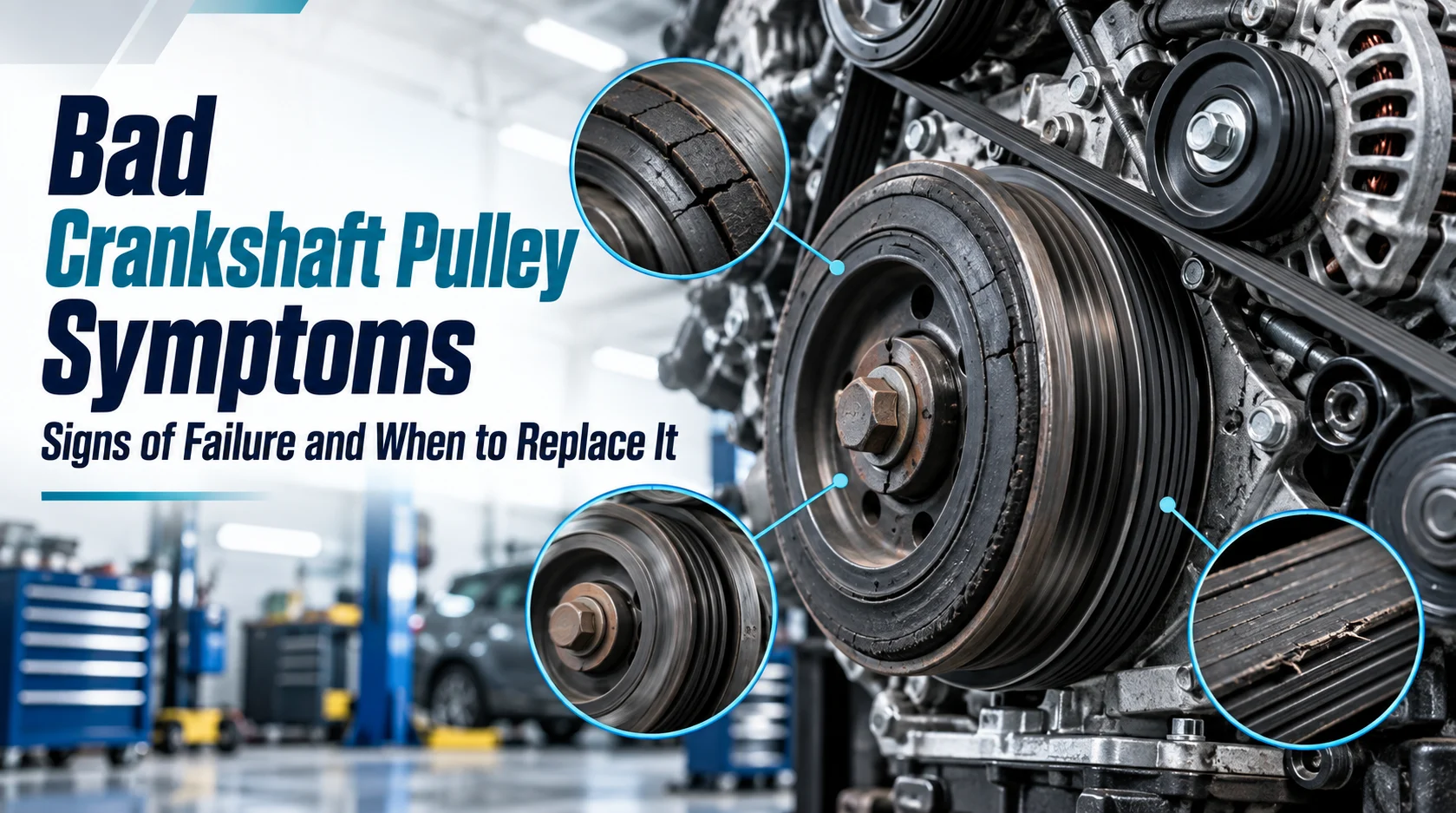
The crankshaft pulley is an important component of a vehicle’s engine, helping transfer rotational power from the crankshaft to various belt-driven accessories. Although it may not receive as much attention as other engine parts, a faulty crankshaft pulley can cause unusual engine noises, excessive vibration, belt problems, and even the failure of essential auxiliary systems.
Many modern vehicles use a harmonic balancer, also known as a crankshaft damper pulley, which incorporates a rubber element designed to absorb engine vibrations. Over time, this rubber can deteriorate, allowing the pulley to become unstable and reducing its ability to control vibration.
Recognising the symptoms of a bad crankshaft pulley early can help prevent further damage and avoid unexpected repair costs. In this guide, we explain the most common warning signs, what causes crankshaft pulley failure, and when replacement may be necessary.
What Does a Crankshaft Pulley Do?
The crankshaft pulley is mounted on the end of the engine’s crankshaft and rotates as the engine runs. In many vehicles, it drives the auxiliary belt, which powers components such as the alternator, air conditioning compressor, and, depending on the engine design, the power steering pump or coolant pump.
Some crankshaft pulleys are simple, solid pulleys, while others incorporate a harmonic damper to reduce torsional vibrations produced by the engine.
These vibrations occur as the engine’s cylinders fire and rotational forces fluctuate. The damper helps absorb these forces, protecting the crankshaft and other engine components from excessive vibration.
When the pulley or its damping element deteriorates, the engine’s accessory drive system may no longer operate smoothly. This can affect belt alignment, accessory performance, and overall engine refinement.
1. Unusual Engine Noises
One of the most common symptoms of a failing crankshaft pulley is an unusual noise coming from the front of the engine.
Drivers may hear squeaking, chirping, rattling, or knocking sounds, particularly when the engine is idling or when the engine speed changes.
These noises can develop for several reasons. A deteriorated rubber damper may allow the pulley to move abnormally, while a damaged pulley can cause the auxiliary belt to track incorrectly. In some cases, the noise may come from a worn belt tensioner, idler pulley, or another accessory driven by the same belt.
A loose or damaged crankshaft pulley bolt can also create serious mechanical problems and should be investigated immediately.
Although engine noises do not always indicate crankshaft pulley failure, persistent or worsening sounds should not be ignored. A mechanic can inspect the pulley, belt alignment, and surrounding components to identify the source.
2. Excessive Engine Vibration
A noticeable increase in engine vibration is another warning sign of a potentially faulty crankshaft pulley.
In vehicles fitted with a harmonic balancer, the rubber damping element helps absorb torsional vibrations. If the rubber becomes cracked, hardened, separated, or otherwise damaged, the pulley may no longer control these vibrations effectively.
Drivers may notice:
- Increased vibration while the engine is idling.
- More noticeable shaking through the steering wheel or dashboard.
- Vibrations that change with engine speed.
- Unusual movement around the crankshaft pulley area.
A damaged harmonic balancer can allow excessive vibration to affect other engine components over time.
However, engine vibration can also result from worn engine mounts, ignition misfires, fuel system problems, or an engine running unevenly. The vibration should therefore be assessed alongside other symptoms before the pulley is replaced.
3. Visible Wobbling or Pulley Misalignment
A crankshaft pulley should rotate smoothly and remain correctly aligned while the engine is running.
If the pulley appears to wobble, oscillate, or move unevenly, it may have a damaged damper, a distorted pulley, a mounting problem, or a related mechanical fault.
Visible wobbling is a particularly important warning sign because continued operation may place additional stress on the auxiliary belt and other drive components.
A pulley that is no longer running true can cause the belt to track incorrectly, wear unevenly, or slip off its intended path.
Safety note: Never attempt to touch, adjust, or closely inspect a rotating crankshaft pulley while the engine is running. If abnormal movement is suspected, switch off the engine and arrange a safe inspection by a qualified mechanic.
4. Auxiliary Belt Slipping or Wearing Prematurely
The crankshaft pulley plays a key role in driving the auxiliary belt. If the pulley becomes damaged, misaligned, or unstable, the belt may not run correctly.
Common belt-related symptoms include:
- Squealing when starting the engine.
- Belt squeaking during acceleration.
- Frayed or cracked belt edges.
- Uneven belt wear.
- Repeated belt replacement without resolving the underlying problem.
A deteriorated harmonic balancer may also allow the outer section of the pulley to shift relative to its inner hub, depending on the pulley design.
However, belt problems are not always caused by the crankshaft pulley. Incorrect belt tension, worn tensioners, damaged idler pulleys, contaminated belt surfaces, and failing accessories can produce similar symptoms.
If a replacement belt develops the same problem shortly after fitting, the complete auxiliary drive system should be checked rather than repeatedly replacing the belt alone.
5. Alternator Charging Problems
The alternator relies on engine rotation, usually transferred through the auxiliary belt, to generate electricity and recharge the vehicle’s battery.
If a failing crankshaft pulley causes the belt to slip or lose effective drive, the alternator may not operate as intended.
Possible symptoms include a battery or charging system warning light, dim headlights, flickering dashboard illumination, and electrical accessories behaving inconsistently.
In more serious cases, the battery may gradually discharge because it is not receiving sufficient charge while the engine is running.
These symptoms can also indicate a faulty alternator, a worn belt, poor electrical connections, or a weak battery. A charging system test can help establish whether the problem is related to the pulley or another component.
If the battery warning light appears alongside belt noise or visible pulley damage, arrange an inspection promptly.
6. Problems With Air Conditioning or Power Steering
Depending on the vehicle’s design, the auxiliary belt may drive the air conditioning compressor and hydraulic power steering pump.
If a faulty crankshaft pulley affects belt movement or drive efficiency, these systems may experience reduced performance.
For example, the air conditioning may become less effective, or the steering may feel heavier in a vehicle that uses belt-driven hydraulic power steering.
The exact symptoms depend on the vehicle. Many modern cars use electric power steering, which does not rely on an engine-driven hydraulic pump.
It is also important to recognise that air conditioning and steering problems can occur independently of the crankshaft pulley. A faulty compressor, refrigerant leak, steering system fault, or damaged accessory can produce similar symptoms.
When several belt-driven systems develop problems at the same time, inspecting the auxiliary drive system may help identify a shared cause.
7. Damage to the Harmonic Balancer’s Rubber Element
In a crankshaft pulley that incorporates a harmonic balancer, the rubber damping element is a critical part of the assembly.
Exposure to heat, oil contamination, ageing, and repeated mechanical stress can cause this rubber to deteriorate.
Visible signs of damage may include cracking, separation, deformation, or rubber material protruding from the pulley assembly.
In some cases, the outer metal ring may begin to shift away from its intended position. This can affect pulley alignment and reduce vibration damping.
Not every crankshaft pulley contains a rubber damper, so the inspection method depends on the engine design.
If the rubber element shows clear signs of deterioration, the pulley should be assessed against the manufacturer’s specifications. A severely damaged harmonic balancer may need replacement even if the vehicle has not yet developed obvious driving problems.
8. Burning Rubber Smell
A burning rubber smell from the engine bay can indicate that the auxiliary belt is slipping, overheating, or rubbing against an incorrectly aligned component.
A damaged crankshaft pulley may contribute to this problem by disrupting the belt’s normal movement.
The smell may become noticeable after starting the engine, accelerating, or operating accessories that increase the load on the belt.
However, the cause could also be a seized accessory pulley, a failing belt tensioner, incorrect belt installation, or another component generating excessive friction.
If the smell is accompanied by smoke, severe belt noise, or visible pulley movement, stop the engine when safe and arrange professional assistance. Continuing to run the engine could cause further damage.
What Causes a Crankshaft Pulley to Fail?
Several factors can contribute to crankshaft pulley failure, depending on the pulley design and the vehicle’s operating conditions.
Age and normal wear
Over time, rubber damping elements can harden, crack, or separate. Metal components can also wear or become damaged through prolonged use.
Heat and oil contamination
High engine temperatures and exposure to leaking engine oil or other fluids can accelerate the deterioration of rubber components.
Excessive vibration
Persistent engine vibration can place additional stress on the pulley and its mounting components.
Auxiliary drive system problems
A seized accessory, failing tensioner, damaged idler pulley, or incorrectly tensioned belt can increase the loads placed on the crankshaft pulley.
Incorrect installation
Using an incorrect pulley, failing to follow the specified tightening procedure, or reusing a fastener when the manufacturer requires replacement can create mounting and alignment problems.
Correct diagnosis is important because replacing the crankshaft pulley without resolving an underlying accessory drive fault may allow the new component to deteriorate prematurely.
When Should You Replace a Crankshaft Pulley?
A crankshaft pulley should be replaced when inspection confirms that it is damaged, excessively worn, distorted, or no longer operating within the manufacturer’s specifications.
Replacement may be necessary if:
- The pulley visibly wobbles or has developed abnormal movement.
- The harmonic balancer’s rubber element is cracked or separated.
- The pulley is damaged and causing persistent belt alignment problems.
- There is evidence of mounting damage or a defective pulley assembly.
- The manufacturer specifies replacement following a particular fault or repair procedure.
A noisy engine alone is not enough to justify replacement. The mechanic should establish whether the pulley is responsible and determine whether other components have also been affected.
If the auxiliary belt has been damaged, it may need replacement as part of the repair. The belt tensioner, idler pulleys, accessory bearings, and crankshaft mounting hardware should also be checked.
Following the vehicle manufacturer’s instructions is essential, as some crankshaft pulleys require specific tools, tightening angles, torque settings, or new mounting bolts.
Can You Drive With a Bad Crankshaft Pulley?
Driving with a suspected faulty crankshaft pulley is not recommended without first assessing the severity of the problem.
A minor issue may initially produce only a noise or vibration, but a severely damaged pulley can affect belt operation and potentially cause the belt to slip off or fail.
Depending on the vehicle, the loss of belt drive could affect alternator charging, power steering assistance, air conditioning, or coolant circulation if the water pump is belt-driven.
If the pulley is visibly wobbling, the belt is fraying, the engine is producing severe knocking noises, or the charging system warning light appears alongside other belt-related symptoms, stop driving and seek professional advice.
The safest response depends on the vehicle’s design and the nature of the fault. If there is doubt about whether the car can be driven safely, recovery is preferable to risking further damage.
How to Choose the Right Replacement Crankshaft Pulley?
Selecting the correct replacement component is essential for reliable engine operation.
Crankshaft pulleys can differ in diameter, belt groove configuration, offset, mounting arrangement, and damping design. Even vehicles from the same model range may use different pulleys depending on the engine variant and production year.
Before ordering a replacement, check the following:
- Vehicle make, model, and year.
- Engine size and engine code.
- Original equipment or manufacturer part number.
- Pulley dimensions and belt configuration.
- Compatibility with the vehicle’s specific engine and auxiliary drive system.
Where possible, confirm the part using the vehicle identification number (VIN) or a verified original part number.
Drivers and repair professionals researching replacement components can explore the automotive parts range at Apex Auto Parts to help identify suitable options for their vehicle.
Choosing a compatible component and following the correct installation procedure can help restore smooth belt operation and effective vibration control.
Final Thoughts
A bad crankshaft pulley can cause several warning signs, including unusual engine noises, excessive vibration, visible wobbling, premature belt wear, charging problems, and reduced performance from belt-driven accessories.
These symptoms can overlap with faults in other engine components, so a proper inspection is important before replacing any parts.
Addressing pulley damage early can help protect the auxiliary drive system and reduce the risk of unexpected breakdowns or additional repair costs.
If you notice persistent rattling, abnormal vibration, belt misalignment, or visible damage around the crankshaft pulley, arrange a professional assessment as soon as possible. Selecting the correct replacement component and resolving any underlying cause will help maintain reliable engine operation over the long term.
Read more : How Automation Software Can Simplify Repetitive Business Tasks