
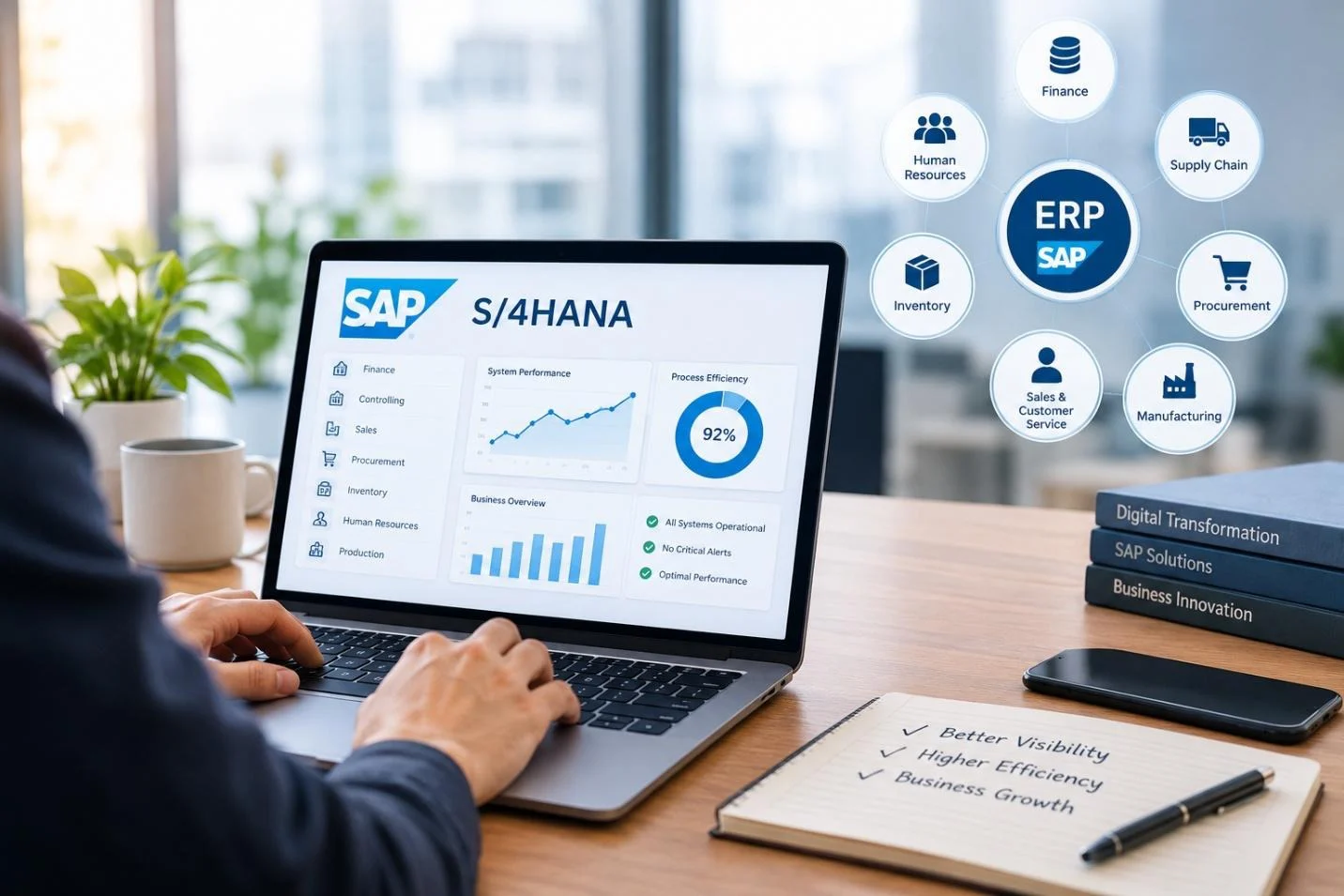
In today’s competitive business environment, companies need reliable systems to manage their operations, monitor performance, and make informed decisions. As organisations expand, handling finance, inventory, procurement, human resources, and customer information through separate tools can become complicated. Enterprise Resource Planning (ERP) systems help address these challenges by bringing essential business processes together in one connected environment.
SAP is one of the best-known providers of enterprise business software. Its solutions help organisations coordinate daily activities, improve access to information, and establish more consistent workflows. Understanding the relationship between ERP and SAP can help businesses determine which technologies best support their operational goals.
Understanding Enterprise Resource Planning
Enterprise Resource Planning refers to software systems that integrate different business functions within a shared platform. Instead of maintaining disconnected records across multiple departments, employees can access relevant information through connected modules and processes.
For example, when a company receives a customer order, the transaction may affect inventory availability, sales records, invoicing, and financial reporting. An integrated ERP system helps connect these activities, reducing the need to enter the same information repeatedly into different applications.
ERP software can support a wide range of functions, including accounting, supply chain management, manufacturing, purchasing, project management, and workforce administration. The specific capabilities available depend on the selected platform, configuration, and business requirements.
By connecting operational data, ERP systems can also help managers identify bottlenecks, track important performance indicators, and make decisions based on more consistent information.
What Is SAP, and How Does It Relate to ERP?
SAP is a software company that develops enterprise applications for organisations of different sizes and across various industries. Its portfolio includes ERP solutions designed to help businesses manage interconnected operations, financial processes, and resources.
SAP should not be confused with ERP itself. ERP describes a category of business software, while SAP is a provider whose products include ERP systems. Other vendors also offer ERP platforms, and each solution has different features, implementation requirements, and costs.
SAP S/4HANA is one of SAP’s principal ERP product families. It is designed to support integrated business processes and uses the SAP HANA database technology. Depending on the edition and deployment model, businesses may use cloud-based or other supported environments to run their operations.
The appropriate SAP solution depends on factors such as company size, existing technology, regulatory obligations, operational complexity, and long-term plans.
Why SAP Monitoring Matters for Business Operations
Implementing an ERP platform is only one part of maintaining reliable business operations. Once SAP systems are running, organisations also need to understand their performance, identify technical problems, and resolve issues before they significantly affect employees or customers.
SAP Monitoring can be an important part of this process. Monitoring helps IT teams observe system health, identify unusual behaviour, and investigate performance issues that may affect business-critical applications. Depending on the tools and configuration used, teams can track relevant metrics, review alerts, and investigate potential bottlenecks.
Proactive monitoring is particularly valuable for organisations that rely on SAP for financial transactions, production planning, inventory management, or order processing. If a system becomes slow or an important service stops responding, delays can spread across connected business processes.
Establishing appropriate monitoring practices helps technical teams identify potential problems earlier and make more informed decisions about troubleshooting and system maintenance. It can also support capacity planning by helping teams understand resource usage and recognise patterns that may indicate future performance constraints.
Key Benefits of ERP and SAP Solutions
One of the main advantages of an integrated ERP environment is improved coordination between departments. When finance, purchasing, inventory, and sales use connected processes, employees can work with more consistent information and spend less time reconciling separate records.
Greater operational visibility: Managers can review business information through reports and dashboards, helping them understand current performance and identify areas that require attention.
More consistent processes: Standardised workflows can reduce repetitive administrative tasks and help teams follow established procedures. Automation may also reduce manual data entry and the risk of avoidable errors.
Improved financial management: Integrated financial processes can help organisations track expenses, monitor cash flow, manage invoices, and prepare reports more efficiently. The actual benefits depend on data quality and how the system is configured.
Better inventory control: Businesses can use connected inventory and purchasing processes to monitor stock levels, review demand, and plan replenishment. This can be especially useful for manufacturers, distributors, and retailers managing multiple locations.
Support for business growth: A well-planned ERP environment can provide a foundation for expansion by connecting new departments, locations, and business processes as organisational needs evolve.
The Importance of SAP Monitoring Integrations
Modern business environments rarely depend on a single application. SAP systems often operate alongside databases, cloud services, reporting platforms, and other business applications. Understanding how these components interact is important for maintaining reliable operations.
SAP Monitoring integrations can help organisations approach monitoring across connected systems more effectively. Integrating relevant monitoring data can give IT teams a broader view of application performance and make it easier to investigate issues that cross system boundaries.
For example, an employee may experience delays in an SAP business process because of an issue in a connected database, an external service, or another supporting component. Looking at SAP performance in isolation may not reveal the full cause. A connected monitoring approach can help technical teams correlate relevant signals and narrow down where an issue originates.
When evaluating monitoring integrations, businesses should consider compatibility with their existing infrastructure, the quality of available performance data, alerting capabilities, and how easily teams can investigate incidents. The goal is to make technical information more useful and actionable rather than simply increasing the number of dashboards and notifications.
Common Business Applications of SAP ERP
ERP requirements vary significantly between industries, but several business functions commonly benefit from integrated software.
Manufacturing companies may use ERP systems to coordinate production planning, material requirements, purchasing, and product costing. Connecting these processes helps teams understand whether the necessary resources are available to meet production schedules.
Retailers and distributors can use integrated applications to manage procurement, inventory movements, sales orders, and financial transactions. Better coordination can improve stock visibility and support more reliable order fulfilment.
Service-based organisations may focus on project accounting, workforce planning, billing, and resource allocation. Connecting these activities can help managers monitor project costs and understand how effectively resources are being used.
Finance departments can benefit from more integrated reporting and accounting processes. Depending on the implementation, SAP solutions may help businesses coordinate financial information across entities, locations, and operational units.
These examples illustrate why organisations should evaluate ERP requirements according to their actual workflows rather than choosing software solely because it is widely used.
Challenges of Implementing an ERP System
Despite its potential benefits, implementing an ERP system is a significant business project. The software alone does not guarantee better performance. Successful adoption requires careful planning, suitable configuration, reliable data, and employee participation.
Data migration is one important challenge. Information stored in legacy applications must be reviewed, cleaned, and transferred appropriately. Inconsistent product records, duplicate customer details, and outdated financial information can create problems if they are carried into the new environment.
Employee training is equally important. Staff members need to understand how the system affects their responsibilities and how to complete their tasks within the new workflows. Without adequate support, employees may struggle to adopt the platform or develop workarounds that undermine the intended benefits.
Businesses should also establish a realistic budget and implementation schedule. Licensing, consulting, integrations, infrastructure, training, and ongoing maintenance can all contribute to the total cost. Clear project ownership and measurable objectives help organisations manage these commitments.
How to Choose the Right ERP Approach
Before selecting an ERP platform, businesses should document their most important operational challenges. They should identify which processes need improvement, what information must be shared between departments, and which reports managers need to make timely decisions.
It is also useful to assess existing applications and integration requirements. Replacing every system may not always be necessary, but the chosen architecture should allow critical business information to move securely and reliably between applications.
Organisations should compare deployment options, scalability, security controls, support arrangements, and the availability of relevant industry functionality. A demonstration using realistic business scenarios can help stakeholders determine whether a solution fits their needs.
Finally, companies should define success before implementation begins. Useful measures might include shorter order-processing times, fewer inventory discrepancies, faster financial closing, or reduced manual administration. Tracking these indicators provides a practical way to evaluate whether the investment is delivering meaningful improvements.
Conclusion
ERP and SAP solutions can help businesses connect essential operations, improve access to information, and establish more efficient workflows. From financial management and inventory control to manufacturing and project accounting, integrated enterprise software can provide valuable support for organisations dealing with increasingly complex operations.
However, achieving these benefits requires more than selecting a recognised software provider. Businesses need clear objectives, reliable data, appropriate system configuration, and effective employee training. Ongoing performance monitoring and well-planned integrations can also help IT teams maintain visibility across critical systems and respond to technical issues more effectively.
By evaluating their requirements carefully and combining a suitable ERP strategy with effective monitoring practices, organisations can build a technology environment that supports current operations, system reliability, and future growth.
Read more : Why User Experience Matters in Successful Software Products