In today’s fast-moving digital communication world, text slang changes faster than ever. Words are shortened, meanings evolve, and new expressions appear every day across platforms like TikTok, Snapchat, Instagram, and messaging apps. One such popular abbreviation that often confuses users is “ION.”
Many people search online asking, “What does ion mean in text?” because it appears in casual conversations, captions, and even memes. Interestingly, “ION” can have more than one meaning depending on context, tone, and platform. It can be a slang expression, a shorthand for “I don’t,” or even relate to scientific terminology in formal contexts.
In this detailed 2026 guide, we will break down everything about ION meaning in text, its usage, real-life examples, variations, tone differences, and how it fits into modern digital communication. We will also explore related slang like IKYFL meaning, and explain how these expressions shape online conversations today.
By the end of this article, you will clearly understand how to use “ION” correctly, avoid confusion, and communicate more naturally in texting culture.
What Does ION Mean in Text? (Main Definition)
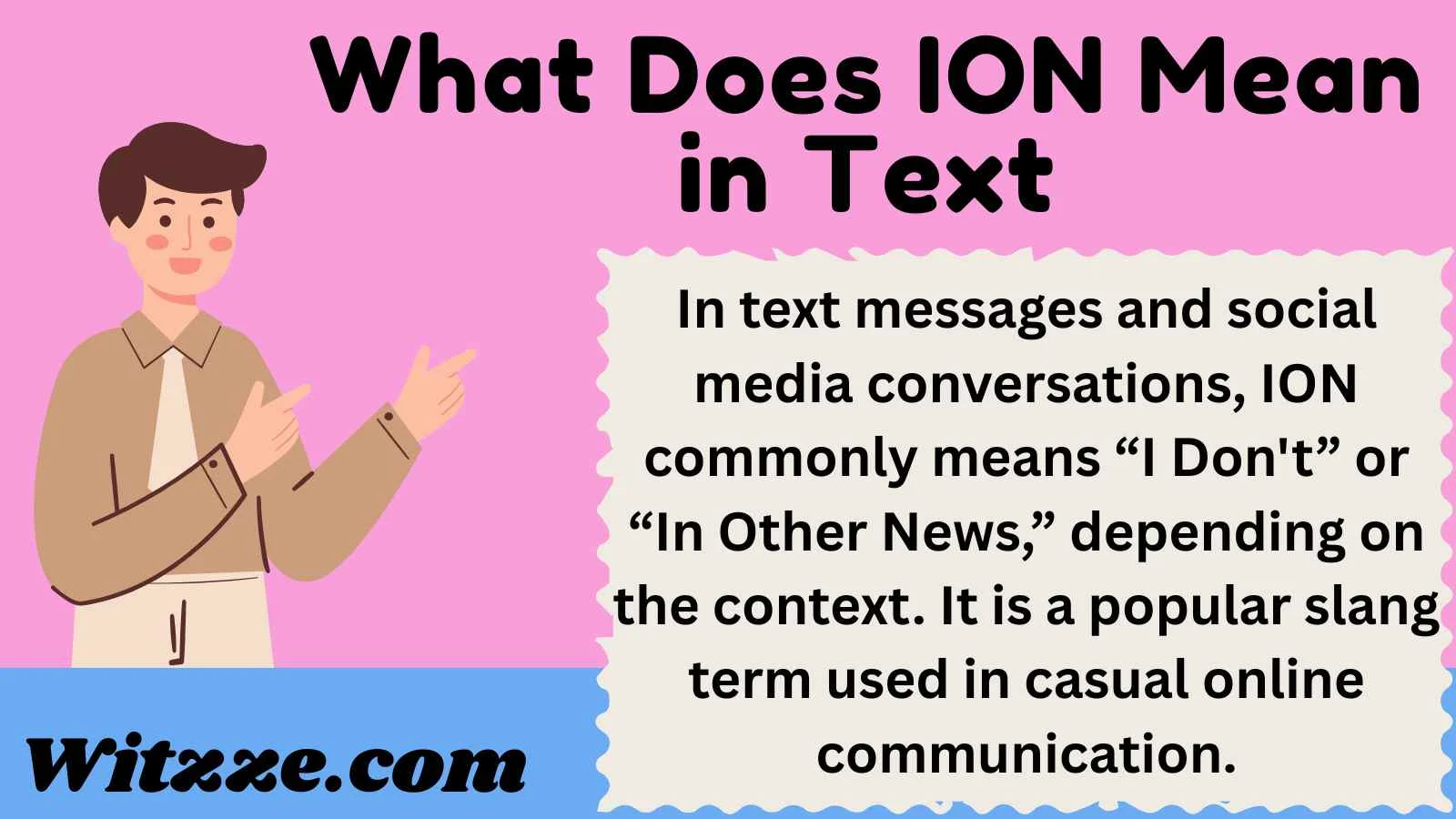
In most modern texting and social media contexts, “ION” stands for “I don’t.”
It is a simplified slang version often used in casual speech and typing when people want to express disagreement, denial, or a personal opinion.
Example usage:
- “ION care what they say.”
- “ION know about that situation.”
- “ION think that’s a good idea.”
Why people use it:
- Faster typing
- Casual tone
- Social media style communication
- Influence from African American Vernacular English (AAVE) slang patterns
In 2026 digital communication trends, abbreviations like “ION” are widely used in informal chats, especially among younger audiences who prefer short, expressive messaging styles.
Alternative Meaning of ION (Scientific Context)
Outside of slang, ION has a completely different meaning in science:
An ion is an atom or molecule that carries an electric charge due to gaining or losing electrons.
Example:
- Positive ion (cation)
- Negative ion (anion)
However, in texting and social media, this scientific meaning is rarely intended unless the conversation is academic or technical.
How to Understand ION Based on Context
Understanding slang requires reading the context of the sentence. The meaning of “ION” changes depending on how it is used.
1. Casual Conversation
- “ION like that movie.”
👉 Means: I don’t like that movie.
2. Emotional Expression
- “ION care anymore.”
👉 Means: I don’t care anymore.
3. Neutral Statement
- “ION know what happened.”
👉 Means: I don’t know what happened.
4. Scientific Use
- “An ion carries a charge.”
👉 Literal scientific meaning.
Stand for “AND” Meaning in Text (Simple Explanation)
In texting culture, users often shorten “and” in different ways such as:
- “&”
- “n”
- “nd”
However, sometimes people mistakenly write or interpret variations like “AN” or “ION AND” confusion in slang threads, especially in fast typing conversations.
Correct understanding:
- “and” = linking word
- No slang meaning unless stylized in informal writing
Example:
- “Me and you” → “Me & you”
IKYFL Meaning in Text (Important Modern Slang)
Another trending abbreviation often searched alongside “ION” is IKYFL, which stands for:
“I know you f*ing lying.”**
It is used to express shock, disbelief, or strong reaction to something unbelievable or ridiculous.
Tone:
- Strong emotional reaction
- Informal
- Often humorous or sarcastic
Examples:
- “He said he finished the whole project in 10 minutes.”
- “IKYFL 😂”
- “She didn’t show up again after promising.”
- “IKYFL…”
This slang is very common in meme culture and reaction-based conversations.
Why Slang Like ION and IKYFL Became So Popular (2026 Trend Insight)
Modern communication is evolving rapidly due to:
- Short-form video platforms
- Meme culture
- Fast-paced texting habits
- Mobile-first communication
- AI-assisted chatting and predictive text
By 2026, digital users prefer expressions that are:
- Short
- Emotional
- Easy to type
- Context-driven
Slang like ION, IKYFL, FR (for real), ONG (on God), and IDC (I don’t care) has become a major part of online identity.
Tone Differences in Using ION
The tone of “ION” depends on how it is delivered in a sentence.
1. Casual Tone
- “ION know lol.”
👉 Friendly and relaxed
2. Strong Tone
- “ION care anymore.”
👉 Emotional or serious
3. Defensive Tone
- “ION do that stuff.”
👉 Denial or clarification
4. Humorous Tone
- “ION even try today 😂”
👉 Funny or playful
How to Use ION Correctly in Texting
To use “ION” properly, follow these simple rules:
- Use it only in informal conversations
- Avoid it in professional emails
- Pair it with casual sentence structure
- Understand your audience
Correct:
- “ION think that’s true.”
Incorrect:
- “ION submit the official report.” ❌
10 Real-Life Texting Examples Using ION (Modern Usage)
Here are 10 practical examples showing how “ION” is used naturally in conversation:
- “ION know what you’re talking about.”
- “ION like this weather today.”
- “ION care what people think anymore.”
- “ION remember where I put my phone.”
- “ION think he will come.”
- “ION understand this assignment at all.”
- “ION feel like going outside.”
- “ION believe she said that.”
- “ION want to argue about it.”
- “ION even try anymore 😂”
These examples show how flexible and expressive the slang is in everyday digital communication.
Common Mistakes People Make with ION
Many users misunderstand or misuse “ION” in texting.
Mistake 1: Using it formally
- Incorrect: “ION submit my application.”
- Correct: “I don’t submit my application.”
Mistake 2: Confusing it with science
Not every “ION” refers to chemistry.
Mistake 3: Overusing it
Using slang too much can make messages unclear.
ION vs I Don’t – Key Difference
| Feature | ION | I Don’t |
|---|---|---|
| Style | Slang | Formal/Standard |
| Usage | Casual texting | All contexts |
| Tone | Relaxed, modern | Neutral |
| Audience | Young/online users | Everyone |
Why Understanding Slang Like ION Matters in 2026
Language is constantly evolving, especially online. Understanding slang helps you:
- Communicate better with younger audiences
- Understand social media conversations
- Avoid confusion in chats
- Stay updated with digital culture
In 2026, communication is not just about grammar—it’s about context, speed, and expression.
Conclusion
The slang term “ION” is a powerful example of how digital communication continues to evolve in 2026. While it most commonly means “I don’t” in texting, it can also vary depending on context. From casual chats to social media posts, it helps users express thoughts quickly and emotionally.
At the same time, related slang like IKYFL shows how expressive modern online language has become. These abbreviations are not just shortcuts—they are a reflection of how people communicate in a fast, digital-first world.
However, it is important to use slang appropriately. While “ION” works perfectly in informal settings, it should be avoided in professional or academic writing. Understanding the difference helps you communicate more effectively and naturally in any situation.
As digital language continues to evolve, staying updated with terms like “ION” ensures you remain fluent in modern communication trends.