
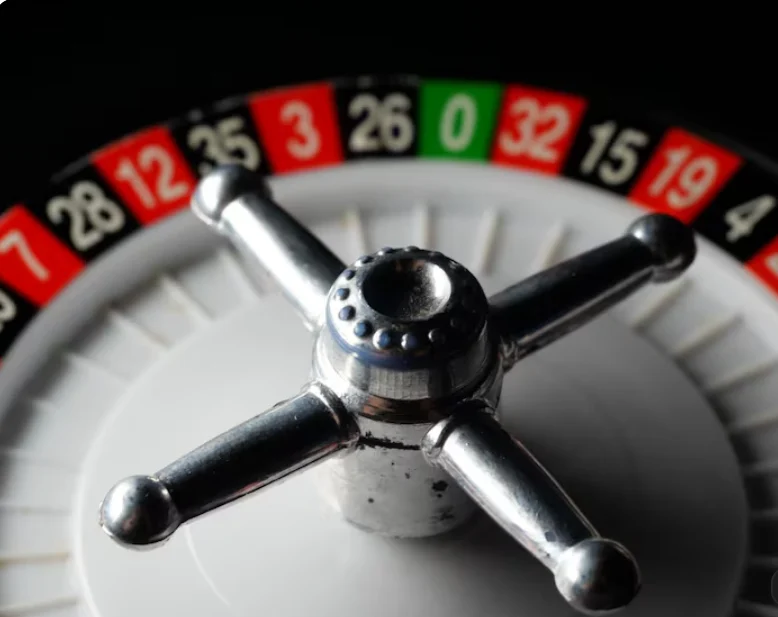
The ball leaves the dealer’s hand, and your attention follows it. At first, its movement looks steady: a small white shape tracing the rim above the turning numbers. Then the sound changes. The circles tighten, the ball drops, and several sharp contacts interrupt its path. For a moment, the pocket you selected seems possible. Then the movement stops, replacing anticipation with a definite result.
That short passage helps explain roulette’s distinctive place in the kasino experience. It gives uncertainty a beginning, a visible progression and an unmistakable conclusion. The title’s “15-second eternity” describes how concentrated that interval can feel. Actual release-to-settlement times vary with equipment, launch conditions and game format; roulette does not operate on a universal stopwatch.
What matters to the player is the changing character of the wait. The opening rotation, the unsettled descent and the final pocket each ask for attention in a different way.
Release: your selection becomes something to watch
Before the launch, your attention may be divided between the betting layout, your chips and the people nearby. Once the round is underway and betting closes, the wheel becomes the central reference point.
A decision you made on a flat grid now has a moving counterpart. Perhaps you selected red, a dozen or one number. The ball gives that selection a destination to wait for.
This transition is an important part of roulette’s emotional pacing. Choosing and watching are different activities. The first involves deciding what to commit; the second involves accepting that the outcome is beyond your direction.
You may lean closer or become quieter. Another player may continue a conversation. The same sequence can produce different levels of involvement, so excitement should never be treated as an identical response shared by everyone.
Circulation: repetition establishes the rhythm
During the opening circles, the ball follows a comparatively regular path. The rotor turns beneath it, carrying the pockets through the field of view.
The repetition gives you time to recognise the event without resolving it. Your selected outcome remains possible, alongside every other eligible result.
From an experience-design perspective, this is the preparation before the dramatic change. The opening movement establishes a pattern that the descent will interrupt.
A physical wheel produces this sequence through motion and contact. In digital presentations, animation or camera work determines how clearly it reaches the player. Someone browsing online roulette may encounter different formats, so the particular game description matters: a live broadcast and a computer-generated wheel communicate the event through different means.
Descent: the pattern breaks
As the ball loses speed and leaves the outer track, its movement becomes less regular. Contacts with deflectors and pocket separators produce changes in direction and sound.
This is often the most visually concentrated part of the spin. A ball that appeared to travel smoothly now moves through short, uncertain-looking steps.
You may find yourself following individual pockets rather than the wheel as a whole. A brief passage near your number can feel significant, even though proximity alone does not predict the settled result.
That distinction matters. The spectacle invites interpretation, but its visible drama does not provide a dependable instruction for the next bet.
Settlement: possibility becomes an answer
The ball comes to rest, the result is confirmed, and the round acquires a clear ending.
Your reaction depends partly on what you selected. A winning result may bring satisfaction or relief. A loss may produce disappointment, indifference or an urge to replay the final bounce in your mind.
The ending also changes how the preceding seconds are understood. The same wait can be remembered as enjoyable suspense after a win and frustrating delay after a loss.
Roulette therefore offers a useful setting for discussing the peak-end rule: the tendency, demonstrated in psychological research, for retrospective evaluations to give substantial weight to an experience’s most intense moments and its ending, rather than simply averaging every moment.
What the peak-end rule can explain
The principle offers a lens for examining roulette’s emotional structure. The unsettled final movement may provide an intense moment, while the confirmed pocket supplies closure.
Those moments can become prominent in memory. You may recall the final bounce more clearly than the early circles, even though both belonged to the same spin.
The research does not establish that roulette delivers a precisely optimised adrenaline response. Foundational experiments examined other experiences, including discomfort, while later work also investigated pleasurable evaluations. Applying the principle to roulette is an interpretation of its pacing, rather than proof of a deliberately engineered psychological formula.
It also helps explain a practical limitation of memory: a vivid ending cannot summarise an entire session’s financial result. One memorable win may stand out while several less dramatic losses receive little attention.
The screen must preserve clarity through the drama
For modern roulette interfaces, emotional pacing works best when the result remains easy to understand. Players need to distinguish an animation still in progress from a confirmed outcome, then see how their selections were settled.
Sound, movement and visual emphasis can support that sequence. They become less useful when they obscure balances or make the actual result difficult to identify.
For adults following the kasino download link, the destination is Betika Tanzania’s broader betting application. Its Google Play listing advertises kasino games and carries an adults-only, 18+ rating.
Whatever the device, the essential requirement is the same: the player should be able to follow the round and understand its conclusion.
Let the ending remain an ending
For adults exploring an online kasino, roulette’s appeal can lie in this compact emotional journey: a selection becomes anticipation, movement becomes suspense, and a pocket provides resolution.
There is no need to describe it as the strongest thrill on the kasino floor. Its recognisable rhythm is compelling enough to analyse on its own.
The most useful boundary comes after settlement. A completed spin does not require another wager, and a disappointing ending does not need to be replaced immediately. You can appreciate the choreography while keeping your time and spending limits independent of its final bounce.